
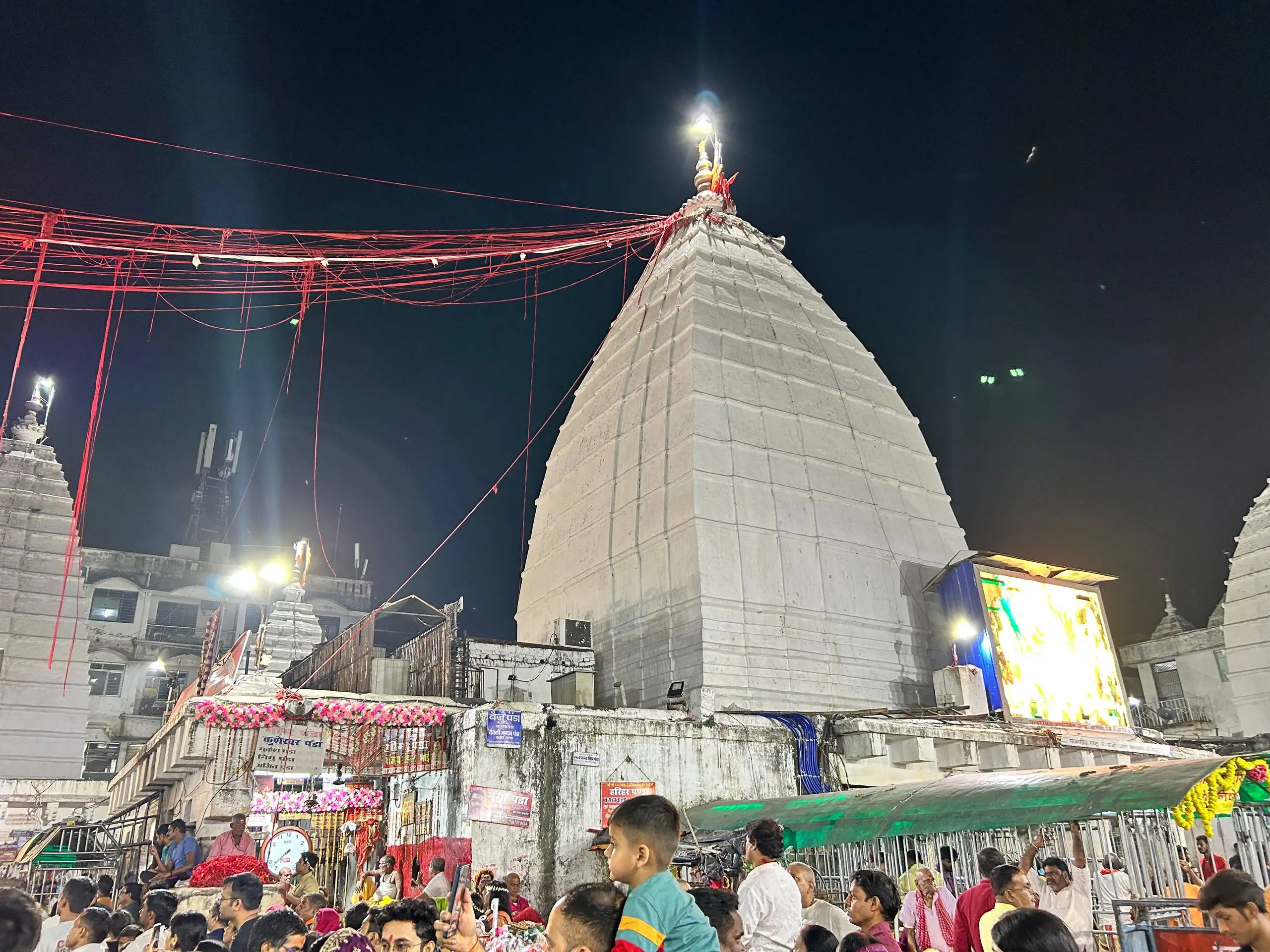




Do you want to visit Baba Baidyanath Dham and have a peaceful darshan? Then this detailed guide is for you. In this blog post, I will explain how you can plan your visit, the best time to go, and what steps you need to follow for a smooth experience.
Recently, my family and I went on a trip to Deoghar, and from that journey I’ve prepared this guide. It’s based on real experiences, so you’ll get practical tips that will help you when you visit Baba Baidyanath Dham yourself.
Are you Visiting Deoghar? Check: Best Places To Visit In Deoghar
How We Reached Deoghar
Day 1 – So, the day finally came when we were going to Deoghar. Early in the morning, after getting ready and having breakfast, we all sat in the rented car. First, we went to my father’s friend’s house, where his family also joined us. With a cheerful “Jai Shree Mahakal,” we started our trip.
Before leaving the town, the car was filled with petrol and the tyres were checked. Our journey was about 180 km (Hiranpur To Deoghar via Car), which usually takes 3–4 hours. On the way, we had already planned to stop at ‘Basukinath Temple in Dumka” for darshan.
Soon after crossing Dumka, we saw the board for Baba Basukinath Temple and turned towards it. At the entry point, we paid a small toll tax (around ₹40). After parking the car, we walked about 200 meters to reach the temple premises.
Outside the temple, some guides were offering help for darshan. You can say yes or no to them—it’s completely your choice. We agreed to one guide, who quickly took us inside through a shortcut. Since it was off‑season and afternoon time, there was no huge crowd, and we really got darshan within just 2 minutes. Honestly, it felt like a blessing! After darshan, we visited the holy pond, clicked some photos, and spent a little time in the temple area before continuing our journey. It was peaceful and soothing.
Important Note: Since, this temple fall under the Dumka region. I’ve already written a detailed post about the “Best Tourist Places In Dumka”. And Dumka is just 80kms away from Deoghar. You may give it a chance too, if Possible.
By then, it was almost 2 PM and we were hungry. On the way, we found a small main roadside hotel in a remote area. They served us hot, fresh rotis and paneer masala, which was safe and hygienic (my brother personally checked everything including the preparation of the foods). After lunch, we continued towards Deoghar and reached around 4 PM.
Once we arrived, we started looking for a hotel. Since we needed it only for one night, we preferred a mid‑range option. After about an hour of searching, we found a decent hotel for around ₹1000 for a family of four (So, we took two rooms for two families). We checked in, took some rest, got fresh, and finally prepared ourselves to explore Deoghar in the evening.
Evening at Ghanta Ghar & Sandhya Aarti In Temple
After resting at the hotel, we felt fresh and relaxed. So, we decided to spend the evening at Ghanta Ghar Market in Deoghar. This area has a long stretch of shops that goes almost up to the temple premises.
When we reached, the market wasn’t too crowded—just a normal evening rush. Suddenly, we thought, why not see the evening aarti at Baba Baidyanath Temple? Since it was exactly the time for aarti, we quickly went towards the temple.
Inside the temple courtyard, many people were sitting peacefully. A big digital screen was showing Baba’s darshan, and everyone was watching quietly. We also sat there for a while, soaking in the calm atmosphere.
Soon, the evening aarti began, similar to a Ganga aarti style. It lasted about 5–10 minutes, and the energy was truly positive.
After the aarti, we decided to return early the next morning for proper darshan, so we didn’t want to waste time. We left the temple, collected our footwear from the main gate, and went back to the market.
There, we did a little shopping and stopped at a hotel near Ghanta Ghar for snacks. We ordered chowmein—one plate each—and enjoyed it together. Later, while the mothers continued shopping for another hour or two, we slowly made our way back to the hotel.
Some of us skipped dinner, but others wanted to eat, so we again went to a nearby hotel at Ghanta Ghar for dinner. After that, we returned, got fresh, and finally went to sleep—ready for the big day ahead.
Quick Summary
- Baba Baidyanath Aarti Time – Between 7:00-7:30 (May change by seasons)
- Baba Baidyanath Aarti Booking – I don’t think anyone need to book anything to see the Aarti. Just go between 6:30 PM – 7:30 PM and you may see the Baba Baidyanath Dham Aarti Live.
Best Time to Visit & Temple Timings (Updated Info.)
If you want to have a peaceful darshan at Baba Baidyanath Dham, remember this tip: go as early in the morning as possible. Crowds are much smaller, and the experience feels calmer.
We woke up at 4 AM, but by the time we got ready and left the hotel, it was already 5 AM. We hired a toto (local auto rickshaw), which charged ₹100 for 8 people. In just 5 minutes, the driver dropped us near one of the temple gates. Since it was still dark with only a little daylight, the atmosphere felt very spiritual and little cold.
At the gate, shopkeepers were selling puja items like flowers and Ganga jal. We bought the essentials and quickly moved towards the temple courtyard. Normally, during peak season, the lines stretch for kilometers, but at that time there was no heavy crowd. Still, we felt like thousands of people were ahead of us, and within minutes, even more people joined behind us.
This is why every second matters here—don’t waste time. If you want blessings from Lord Shiva in a one‑day trip, you need to stay active and alert. The crowd keeps moving every one minute of approx. timings, devotees continuously chant “Jai Mahakal” and “Har Har Mahadev,” which gives you energy and positivity.
It took us about 2–3 hours to reach near the sanctum. At one point, the VIP line merged with ours, but that’s fine—Lord Shiva belongs to everyone. Finally, when we entered the temple, the space was very tight and crowded. Honestly, it was tough, especially for children or elderly people. I held my mother’s hand tightly and somehow managed to offer flowers to Baba Baidyanath.
My younger sisters (aged 16–23) struggled to get a clear view, but eventually, everyone in our group had darshan. After that, we felt completely energized, relaxed, and filled with positivity. We sat for a while in the temple area, clicked some photos, and also visited nearby small temples to offer prayers. After spending 30–45 minutes more, we came out of the temple.
Baba Baidyanath Dham Temple Opening & Closing Timings
Generally, The temple gets open at 4 AM in the morning but if talking about Darshan timings for general public – then it is from 5:30 AM morning to 9:00 PM at night (Daily).
| Time | Ritual Name | Description |
Participant Accessibility
|
| 04:00 AM | Mangal / Kakad Aarti | Temple opens for morning worship and first prayer. |
Open for public Darshan
|
| 04:10 AM | Kancha Jal | First water offered to the lingam. | Not in source |
| 04:15 AM – 05:30 AM | Abhishekam & Shodashopachar (Sarkari Puja) | Priests perform the formal bathing and 16-step worship. |
Restricted to priests (Sarkari Puja)
|
| 05:30 AM – 09:00 AM | General Morning Darshan | Public gets darshan after the formal puja. |
Open for devotees
|
| 12:00 PM | Bhog / Midday Offering | Food offering presented to the deity. | Not in source |
| 02:00 PM – 03:30 PM | Midday Closing | Temple closes for midday cleaning and rest. | Restricted |
| 06:00 PM | Sandhya (Evening) Aarti | Evening worship and doors re-open for darshan. |
Open for public Darshan
|
| 06:10 PM – 07:30 PM | Shringar Puja | Deity is decorated with seasonal water, flowers, and ornaments; evening aarti follows. | Not in source |
| 07:30 PM | Maha Aarti | Grand evening prayer ritual. |
Open for public Darshan
|
| 08:00 PM – 09:00 PM | Shayan (Night) Aarti & Closing | Final aarti and temple closes for the night. | Not in source |
My Personal Experience
Listen, if you really want to have a quick and peaceful darshan at Baba Baidyanath Dham, you should get in line before 4 AM. By the time we reached, it was already 5 AM—and that small delay made a big difference.
⚠️ Travel Tip: Don’t repeat our mistake. Arrive as early as possible so you can avoid heavy crowds and finish darshan smoothly.
| Mode of Transport | Point of Origin / Hub | Distance (Inferred) | Travel Time (Inferred) | Travel Details / Specifics |
| Air | Deoghar Airport (DGH) | 9.1 km | 15–30 minutes |
Closest airport to Baidyanath Dham. Domestic flights connect major cities. Transfer via taxi or pre-paid cab.
|
| Rail | Baidyanathdham Station | 2.2 km | 5–10 minutes |
Local rail link terminal specifically serving the temple town area.
|
| Rail | Jasidih Junction | 8.1 km | 15–30 minutes |
Easiest rail stop; many express trains stop here. Connects to the temple via taxi, auto, or local MEMU shuttles.
|
| Local Transport | Deoghar Town / Bus Stand | 1.3 km | 10–20 minutes |
Taxis, app cabs, and autos are widely available. Seasonal special trains run during Shravani Mela.
|
| Road / Bus | Sultanganj | 118 km | 2.5–4 hours |
Key point for pilgrims, especially during Shravani Mela when they carry water from here.
|
| Road / Car | Patna | 250 km | 3.5–6 hours |
Major regional airport hub and state capital. Connects to Deoghar via direct road route or rail. Good for private vehicles.
|
| Road / Car | Ranchi | 277 km | 4–6 hours |
Travel from Jharkhand’s capital via state-run or private buses and cars.
|
| Road / Car | Kolkata | 331 km | 6–9 hours |
Major international and domestic hub; pilgrims often prefer train or flight connections, or use overnight bus services.
|
Best Time to Visit Baba Baidyanath Temple
| Season | Months | Weather Conditions | Key Festivals |
Crowd Level (Inferred)
|
| Monsoon | July – August | Rainy, warm, wet roads; heavy showers some days | Shravani Mela | Very High |
| Winter | October – March | Cool days, low rain | Maha Shivratri (Feb/Mar) |
Moderate (Busy during Maha Shivratri)
|
| Spring/Post-Monsoon | January, September | Not in source | Basant Panchami (Jan), Bhadra Purnima (Sept) | Moderate |
| Summer | April – June | Hot days, humid; temperatures rise | Not in source | Low |
Big Festivals, Events & Puja Dates 2026 At Baba Baidyanath Dham
These are the upcoming festivals and events that are going to be celebrated in this temple officially this year. Please note – These data’s are taken from their official site.
| Puja | Schedule |
|---|---|
| Amavasya Puja (Maa Kali & Tara) | Every Amavasya |
| Mangalvari Puja | Every Tuesday |
| Nitya Puja Shringar & Bhog | Daily (Morning & Evening) |
| Ekadashi Puja | Every Ekadashi |
| Shree Yantra Raj Rajeswari Puja | Daily |
| Adra Bhog | From 22 June (Asharh) |
| Shrawani Puja | Full Shravan Month |
| Dahi Chura Bhog | Full Agrahan Month |
| Makar Sankranti Bhog | Full Magh Month |
Upcoming Hindu Festivals & Puja Dates 2026
Following the festival calendar is an important part of Hindu tradition and devotion. To help devotees plan their prayers, temple visits, and fasting days, here is a list of important upcoming Hindu festivals and puja dates in 2026.
From January to March 2026, many sacred occasions like Makar Sankranti, Basant Panchami, Maha Shivratri, and Holi Puja will be celebrated. These days are considered highly auspicious for worship, charity, and spiritual activities.
| Festival / Puja Name | Date / Tithi |
|---|---|
| Gouri Shankar Puja | 14 Jan 2026 |
| Makar Sankranti | 14 Jan 2026 |
| Basant Panchami (Maa Saraswati Puja) | 23 Jan 2026 |
| Makuri Saptami | 25 Jan 2026 |
| Maa Tara Puja | 25 Jan 2026 |
| Surya Narayan Puja | 25 Jan 2026 |
| Maa Bagla Puja | 1 Feb 2026 |
| Maha Shivratri Puja | 15 Feb 2026 |
| Anand Bhairav Puja | 24 Feb 2026 |
| Holi Puja (Chhapan Bhog) | 3 Mar 2026 |
| Gamali Puja | 10 Mar 2026 |
| Chaitra Shukla Navratra | 20 Mar 2026 |
| Annapurna Puja | 26 Mar 2026 |
| Ram Navami | 27 Mar 2026 |
| Akshaya Tritiya | 20 Apr 2026 |
| Mesh Vishu Shankranti | 14 Apr 2026 |
| Rath Yatra | 16 Jul 2026 |
| Shravan Mela | 30 Jul 2026 |
| Guru Purnima | 29 Jul 2026 |
| Raksha Bandhan | 28 Aug 2026 |
| Jhulan Puja | 23 Aug 2026 |
| Maa Mansa Puja | 17 Aug 2026 |
| Dahi Handi | 5 Sep 2026 |
| Janmashtami | 4 Sep 2026 |
| Ganesh Puja | 14 Sep 2026 |
| Mahakal Bhairav Puja | 9 Sep 2026 |
| Anant Chaturdashi | 25 Sep 2026 |
| Bhadra Purnima | 26 Sep 2026 |
| Jitiya | 3 Oct 2026 |
| Maa Durga Puja | 11–21 Oct 2026 |
| Maa Lakhi Puja | 25 Oct 2026 |
| Kali Puja | 8 Nov 2026 |
| Deepawali | 8 Nov 2026 |
| Kartikay Puja | 17 Nov 2026 |
| Jagat Dhatri Puja | 18 Nov 2026 |
| Devothan Ekadashi | 20 Nov 2026 |
Baba Baidyanath Dham – How to Get VIP Darshan Pass?
Baba Baidyanath Dham in Deoghar (Jharkhand) is one of the most revered Jyotirlinga temples in India. During busy days and festivals, many devotees prefer VIP or Sheeghra Darshan tickets to avoid long queues and ensure a smoother darshan experience.
How & Where to Get VIP Pass?
In Baidyanath Dham, the Sheeghra Darshan coupon (VIP pass) is usually available near the temple premises at designated counters. Devotees can purchase this pass on arrival at the temple, depending on availability. Some websites are available for online bookings too – but I personally don’t recommend those services. If you are looking for VIP Darshan tickets, You should visit the temple office once and learn more about it.
⚠️ Important:
-
Special vip/Sheeghra darshan availability can change on big festival days (e.g., Mahashivratri) when the temple may suspend VIP/paid passes to manage crowds. For example, reports for Mahashivratri 2026 indicate that official VIP worship and special darshan may be restricted or halted by administration decisions, and devotees may be offered only the standard “Sheeghra Darshan” option.
So, while the facility is usually available, always confirm at the temple counter or official notice boards on the day of your visit.
2026 Rate for VIP Pass (Sheeghra Darshan Ticket)
Although Bazaar and travel guides quote various figures, the commonly found rate for Sheeghra/VIP Darshan at Baba Baidyanath Dham is approximately:
| Darshan Type | Approx. Cost |
|---|---|
| Sheeghra / VIP Darshan Coupon | ₹300-₹1000 per person (≈ expected range) |
This ₹300 figure is widely reported across temple visitor resources, and similar rates are also quoted for Badrinath VIP darshan ticket fees by official bookings in Char Dham contexts.
⚠️ Note:
-
On peak festival days, special darshan pricing or availability may change temporarily as local administration might tweak rules to manage huge crowds.
-
Always check official counters on arrival.
Is It Worthy?
From genuine pilgrim experiences and travel records, here is a clear view:
Yes, for many devotees it is worth it — especially when:
-
Visiting on high-traffic days or weekends
-
You want a to cut 90% line of huge crowds
-
Elderly, differently-abled, or senior family members are part of the group
VIP / Sheeghra Darshan helps you bypass long queues (90-95%), often reducing wait times considerably, and allows a closer view of the sanctum without spending hours standing in crowd lines.
However, there are a few practical points to consider:
-
For devotees who don’t mind standing or are comfortable with crowds, general darshan is still free and spiritually equally valid.
-
Some festival occasions may suspend paid passes due to crowd control; during such times, planning general darshan early in the morning is better.
Personal Suggestion:
- If this is your special pilgrimage or family trip,
- If grandparents or companions have mobility issues,
- Or if you have a tight itinerary,
Then paying ₹300–₹1000 for Sheeghra Darshan can be one of the most practical choices for a stress-free spiritual experience at Baidyanath Dham.

Hi, I’m छाया कुमारी — your blogger girl from Hiranpur itself! 🌸
I love exploring local places, finding useful info, and sharing simple guides that help our community and visitors. From hidden spots to daily-life tips, I write about Hiranpur the way a local lives it — real, helpful, and from the heart.
If it’s about Hiranpur & its nearby area’s, chances are I’ve seen it, tried it, or asked someone who knows it best 😉





[…] Also, Check: Complete Deoghar Baba Baiyanath Temple Darshan Timings Guide […]